
Last updated on September 18th, 2026
If you’re putting together a list of things to do in and around Wiltshire, you’ve landed in one of England’s most rewarding counties to explore. It’s got ancient stone circles that are older than the pyramids, villages so pretty they look staged, and a countryside that rewards you every time you look up from your map. We spent three days here as a family, based ourselves in one spot, and drove out to hit the highlights without ever feeling like we were racing the clock.
This isn’t a giant list of every attraction in Wiltshire. It’s the itinerary we actually followed, with the reasoning behind it, so you can either copy it exactly or tweak it to fit your own trip. To finish, I also give you ways to trim this itinerary or add more places, depending on how much time you actually have in this region.
Here’s the quick version before we get into it:
- Day 1: Stonehenge in the morning, then an afternoon exploring Bradford-on-Avon
- Day 2: A full day trip to Bath
- Day 3: Avebury, Silbury Hill, and the Cherhill White Horse in the morning, then Lacock and Castle Combe
Three days gives you enough breathing room to actually enjoy each place instead of just photographing it and moving on. Let’s get into how to plan it.
Jump to ...
Where Is Wiltshire and How to Get There
Wiltshire sits in South West England, wedged between the M4 corridor and the edge of the West Country. It’s rural, it’s green, and honestly, it’s the kind of place that’s much easier to enjoy by car than by public transport.
Getting to Wiltshire by Car, Train or Bus
Driving is by far the easiest way in. If you’re coming from London, you’re looking at around two hours down the M4 depending on traffic. Trains run into Wiltshire too, with stations in Salisbury, Chippenham, and Bradford-on-Avon connecting to London Paddington and Bristol, but you’ll want a car once you’re actually here.
Getting Around Once You’re There
This is the bit we’d flag early. Wiltshire’s biggest draws, Stonehenge, Avebury, Lacock, Castle Combe, are all rural and spread out. Public transport between them is patchy at best. We rented a car for the whole trip and it made the itinerary possible. If you’re not driving, you’ll need to lean on organized tours to string these places together, which we’ll get into later.
How Many Days Do You Actually Need in Wiltshire
Three days worked brilliantly for us, but we know not everyone has that kind of time.
Trimming to 2 or 2.5 Days
If you’re tighter on time, the good news is you don’t have to cut corners, you just have to choose wisely. Stonehenge and Avebury both do the same job of showing you Neolithic Britain, so you don’t need both. We’ve broken down exactly how they compare in a Stonehenge vs Avebury post. Same goes for Lacock and Castle Combe. Both are gorgeous historic villages, but picking one over the other is a completely reasonable move if you’re short on time, and we’ve laid out the case for each in Lacock vs Castle Combe.
Why 3 Days Is the Sweet Spot
The extra day is what lets you slow down. Instead of ticking off Stonehenge and rushing to the next stop, you get a relaxed afternoon in Bradford-on-Avon. Instead of cramming Avebury, Lacock, and Castle Combe into a sprint, you get a full day to wander all three without watching the clock.
Choosing Bradford-on-Avon as Your Base

We based ourselves in Bradford-on-Avon for four nights, and it turned out to be the smartest logistical call of the whole trip. It sits close enough to Stonehenge, Bath, and Avebury that none of our drives felt like a slog, and it’s a lovely little town in its own right, all honey-colored stone and a river running straight through the middle.
We stayed in one of the terraced houses that climb up the hillside overlooking the town center, a look Bradford-on-Avon is genuinely known for. Rows of stone cottages stack up the slope in tiers, connected by steep little lanes and flights of steps, and more than one local told us it’s what people imagine Bath looked like before it got famous. Our evening view over the rooftops and church spires down to the river was one of our favourite parts of the whole stay, and the walk down into town one evening, all cobbled steps and narrow alleyways, felt like an attraction in its own right.
There’s a practical case for Bradford-on-Avon too, not just a scenic one. Accommodation here tends to run noticeably cheaper than in Bath, which adds up fast over several nights. It’s also a much easier town to drive into and out of, without the maze of one-way streets and tight junctions that can make navigating central Bath a headache if you’re not used to it. And if your accommodation doesn’t come with free parking, you’ll generally find it easier, and cheaper, to find a spot in Bradford-on-Avon than you would trying to park anywhere near central Bath.
If you’re planning your own base, look for somewhere central to this cluster of sights rather than somewhere prettier but further out. Trust us, the extra thirty minutes each way adds up fast when you’ve got three big days planned.
Zoom in and out to choose a place to stay in Bradford-on-Avon:
Day 1: Stonehenge in the Morning and Bradford-on-Avon in the Afternoon
We started our first full day the way most people start their Wiltshire trip, at Stonehenge.
Getting to Stonehenge from Bradford-on-Avon
The drive took us about 50 minutes, mostly through pretty, unhurried countryside. It’s an easy morning trip that still leaves you with a full afternoon.
Stonehenge History and Significance

Stonehenge is one of the most recognizable prehistoric monuments on the planet, and honestly, standing in front of it does something that photos never quite capture. The stone circle dates back around 5,000 years, and what still gets us is that nobody knows for certain why it was built. Theories range from a burial site to an astronomical calendar to a place of healing. We researched and learnt that the bluestones at the site’s centre were somehow transported from Wales, over 150 miles away, which is a genuinely wild feat for the technology of the time.
Wales isn’t far from this part of England. See how we spent a day in the Wye Valley of Wales.
What You’ll See and How to Visit
You won’t be able to walk right up and touch the stones (more on that in a minute), but you’ll get a clear, close view from the marked path that circles the monument with a standard ticket or get into the circle with a special ticket. The visitor centre is worth your time too, with exhibits that give context before you even see the stones, plus a reconstructed Neolithic village.
Amongst all Wiltshire attraction tickets you should consider buying in advance, we’d strongly recommend this one. Stonehenge tickets do sell out, especially in summer. Even at other times of year, advance online tickets purchased via the English Heritage website run a bit cheaper than walk up tickets. However, these tickets are non-refundable. If you like to have flexibility, you can get your tickets from the authorized seller, GetYourGuide.
You’ve also got options beyond the standard ticket, like taking a short tour to the inside of the stone circle, which is outside of normal visiting hours. A more in-depth guided tour gets you a guide who can talk through the history of the entire prehistoric landscape in real depth. Once you enter during your booked time slot, a standard ticket is valid for the rest of the day, but the last entry slot is around 3PM – 2 hours before closing time.
Half-day group tours from London are a solid, budget-friendly way to visit if you’re not driving yourself. Either way, book ahead rather than turning up and hoping. Most full-day group tours from London combine Stonehenge with a visit to Bath and maybe even a visit to Windsor.
Exploring Bradford-on-Avon
We got back to town by early afternoon and just wandered. Bradford-on-Avon doesn’t demand a strict plan, and that’s exactly its charm.
Bradford-on-Avon made its money in the wool and cloth trade back in the 17th and 18th centuries, and that history is stamped all over town if you know where to look. Those tiered stone cottages on the hillside, including the one we stayed in, were originally built to house the weavers who worked the mills down by the river, and you can still trace the old workers’ routes on foot as they wind between the terraces. The town bridge is worth a proper look too. It’s got a tiny stone lock-up perched on one end, a leftover from when it briefly held Bradford-on-Avon’s less well-behaved residents overnight, and it’s one of those small details that’s easy to walk straight past if nobody points it out.
We popped into the Saxon Church of St Laurence, one of the best-preserved Anglo-Saxon churches in England, then walked over to the medieval Tithe Barn, a genuinely massive stone structure that’s easy to miss if you’re not looking for it. From there we spent a happy hour poking around the independent shops and cafes tucked into the town center, and finished up on the riverside path along the Avon, just strolling, stopping for a coffee and stretching our legs. It costs nothing to enjoy, which makes it a great pick if you’re looking for free things to do in Wiltshire with kids, and it’s the kind of unhurried afternoon that felt like exactly the right pace after a busy morning at Stonehenge.
Day 2: A Day Trip to Bath

Our second day was dedicated entirely to Bath, and honestly, it deserves its own spotlight rather than a rushed paragraph here. It’s only about 20 minutes from Bradford-on-Avon, which makes it one of the easiest full days to build into this itinerary.
We spent the day moving between the Roman Baths, wandering past the Georgian sweep of the Royal Crescent, and getting happily lost in the streets around Pulteney Bridge, and even with a full day, we still left feeling like we’d only scratched the surface. Between the Roman history layered under the city, the honey-colored Georgian architecture sitting on top of it, and the buzz of independent shops and cafes filling in the gaps, Bath earns its reputation as one of England’s best city day trips, and it’s easily the busiest, most atmospheric stop on this whole itinerary.
We’ll write a dedicated guide covering everything you need to know for a perfect day trip to Bath from Wiltshire, London or Bristol, so come back soon for that!
Day 3: Lacock, Avebury, the White Horses, and Castle Combe
Our final day was the busiest, but it didn’t feel rushed. We started early and kept moving, and it ended up being our favourite day of the whole trip.
Avebury Stone Circle and the Wiltshire White Horses

Avebury is the lesser-known cousin of Stonehenge, and in some ways, that works in its favour. The stone circle at Avebury Stone Circle in Wiltshire is actually the largest in Europe, and unlike Stonehenge, you can walk right up to the stones, touch them, and wander freely through the site. There’s no ticket, no barrier, and no timed entry. It’s genuinely one of the best free things to do in Wiltshire with kids, since they can run around a UNESCO World Heritage Site like it’s just a big field with rocks in it.
What makes Avebury genuinely fascinating is that it’s not just a circle of standing stones sitting out in a field, it’s a working village built right inside a Neolithic monument. Houses, a working pub, and even the parish church all sit within the henge’s massive earthwork ditch and bank, which has ringed the site for roughly 4,500 years. We had a mid-morning coffee at the Red Lion, reportedly one of the only pubs in the world located inside a prehistoric stone circle, and there’s something wonderfully strange about sipping a drink with a five-thousand-year-old monument as your garden. The National Trust manages much of the site now, including Avebury Manor next door, a Tudor house with gardens that’s worth a quick look if you’ve got a spare half hour.
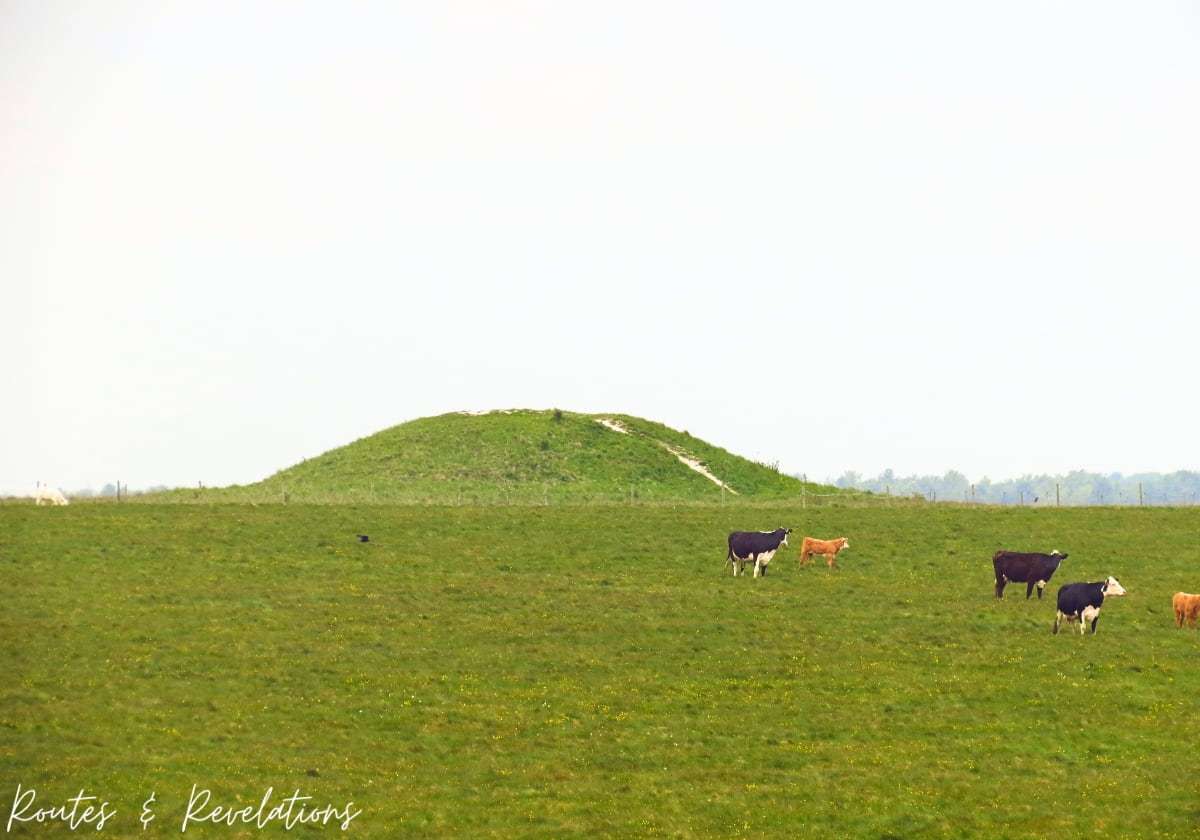
Before we headed back, we took a detour to the A4, just 4 minutes away, to view Silbury Hill, the tallest prehistoric mound in Europe made by man using just primitive tools.
If you want to stretch the morning a little further, West Kennet Long Barrow sits just a few minutes’ drive away and it rounds out the picture of just how much prehistoric activity was concentrated in this one stretch of Wiltshire countryside. We didn’t stop here on this trip, but it’s an easy add-ons if Avebury and Silbury Hill leave you wanting more.

Wiltshire has around a dozen chalk horses cut into its hillsides, though not all of them are visible from the road between Avebury and Lacock. Keep an eye out for the Cherhill White Horse, sometimes called the Lansdowne horse thanks to the monument standing near it, since this one should come into view on the A4 route to the next stop. We didn’t detour for a close-up look, we just spotted one from the car window as we drove, and honestly, that’s enough. It’s a nice, free little moment of history that doesn’t cost you any extra time.
If you’re trying to decide whether Avebury or Stonehenge deserves your time, we’ll soon lay out the full comparison in a Stonehenge vs Avebury post.
Lacock, Historic Village and Filming Backdrop
From Avebury, we drove to Lacock, a village that looks like it hasn’t changed in a couple of hundred years, largely because it hasn’t. It’s owned almost entirely by the National Trust, which means no modern signage, no satellite dishes, nothing to break the illusion.

The village grew up around Lacock Abbey, founded in the 13th century as a nunnery before it was converted into a family home after the dissolution of the monasteries. Centuries later, the Abbey became the home of William Henry Fox Talbot, one of the pioneers of photography, and the oldest surviving photographic negative in the world was taken from one of its windows. If you’ve got any interest in the history of photography, the small museum by the Abbey gatehouse is worth the extra few minutes.
You might also recognize bits of Lacock without ever having set foot there. Its untouched streets have doubled as Hogwarts in several Harry Potter films, with the Abbey’s cloisters unmistakable once you know what you’re looking at, and the village has stood in for various period dramas over the years, including Pride and Prejudice and Downton Abbey. Walking down the high street, lined with timber-framed and honey-stone buildings dating back to the 13th century, it’s easy to see why filmmakers keep coming back.
We spent about two hours wandering the streets, poking into the Abbey grounds, and stopping for a very good pub lunch at the George Inn, one of the village’s oldest pubs, which still has the old dog-wheel once used to turn the kitchen spit built into its fireplace.
Castle Combe, Often Called England’s Prettiest Village

Castle Combe was our last stop, and it earns its reputation as one of England’s prettiest villages. It lies in the southern edge of the Cotswolds, so if you haven’t visited any other part of this area of natural beauty, I highly recommend that you don’t skip this village. Unlike the open rolling hills and larger market squares of the north Cotswolds, Castle Combe lies deep in a hidden, narrow valley, so it’s different enough to visit in addition to the villages I’ve recommended in my Oxford and Cotswolds plan.
Like Bradford-on-Avon, it made its money in the medieval wool trade, and that wealth is still written into the honey-colored stone cottages lining the streets today.
At the heart of the village sits St Andrew’s Church, home to a faceless clock believed to be one of the oldest working clocks in the country, ticking away without a dial since it was only ever meant to be heard, not read. Just below it, the old market cross marks the spot where wool traders once did business, and the packhorse bridge over the By Brook is about as classically English a scene as you’ll find anywhere in Wiltshire.
Castle Combe has also become something of a magnet for film crews, showing up in War Horse, Stardust, and the 2020 Doctor Dolittle, among others, largely because the village has no visible modern intrusions, no overhead cables, no satellite dishes, nothing to give away what century you’re standing in.
Stone cottages, a babbling brook, a market cross in the middle of it all, it’s the kind of place that looks unreal in photos and somehow looks even better in person. One thing worth knowing ahead of time: parking is limited and can fill up fast, especially on weekends, so we’d suggest getting there early in the day or close to the evening.
If you’re deciding between Lacock and Castle Combe rather than doing both, we’ll break down what makes each one worth your time in a separate Lacock vs Castle Combe post.
Best Things to Do in Wiltshire by Traveler Type
Every trip is different, so here’s how we’d adjust this itinerary depending on who you’re traveling with.
Wiltshire for Families and Kids
Avebury is the standout here since there’s space to run and nothing fragile to worry about touching. Bradford-on-Avon’s riverside walk is another easy win for younger kids who need to burn energy between stops. If you’ve got toddlers in tow, stick to the outdoor, open sites like Avebury and the village wandering days, and save the more structured, ticketed visits like Stonehenge for a slower morning pace.
Wiltshire for Couples
Castle Combe and Lacock both lean romantic without even trying, think slow walks, good pub lunches, and pretty backdrops for photos you’ll actually want to keep. Bath, too, has an undeniable romance to it, which is one more reason it earns its own full day rather than a rushed half-day stop.
Wiltshire for History Lovers
This itinerary is basically built for you. Stonehenge and Avebury alone cover thousands of years of history, and Bradford-on-Avon’s Saxon church adds another layer entirely. If ancient history is your main draw, we’d actually suggest doing both Stonehenge and Avebury rather than picking one, since they represent genuinely different eras and building approaches. For Roman and Georgian history and architecture, Bath is just over the border in Somerset.
Wiltshire for Nature Enthusiasts
The drive between sites is half the appeal if you love the outdoors. Rolling hills, chalk horses cut into hillsides, and riverside paths in Bradford-on-Avon all give you plenty of reasons to get out of the car and just look around.
Wiltshire for Solo Travelers, Seniors and Groups
Solo travelers will find this route easy to manage since most stops involve short, well-signed walks rather than anything strenuous. For seniors, Avebury and Lacock are particularly manageable, flat, paved or packed-earth paths, with plenty of places to sit down. Groups will want to book ahead for Stonehenge especially, since group tour options there are genuinely well set up and take the parking and logistics headache off your hands entirely.
Booking Tours, Tickets and Wiltshire Travel Packages

A few practical notes on actually booking this trip.
For Stonehenge, you’ll want to book entrance tickets or tour tickets ahead of time no matter what, since walk-up availability isn’t guaranteed. From there, it’s really a question of private versus group. A private tour costs more but gets you a guide who can go deep on the history and answer questions on the spot. A group tour is more affordable and still gives you a knowledgeable guide, just with less flexibility on timing.
Avebury doesn’t require booking at all, which is honestly one of its best features. The nearest train station is Swindon, from where you can get a bus right to the Red Lion in Avebury.
If you’re not driving, look into Wiltshire guided tour bookings that combine multiple stops, like Stonehenge and Bath and/or Avebury, or Castle Combe and Lacock, in a single day trip from a nearby city. These exist precisely because the public transport gap we mentioned earlier is real, and tour operators have built routes to solve it.
For accommodation, keep an eye out for hotel and attraction deals bundled together, particularly around Bath and Stonehenge, since they’re the two most visited spots in the county and often get paired in weekend package deals.
Here are the highest-rated group tours from cities like Bath and Bristol:
Best Time to Visit Wiltshire
Summer vs Winter in Wiltshire
Summer gives you long daylight hours and the best odds of good weather, which matters when half your itinerary involves walking around outdoor sites. It’s also, unsurprisingly, the busiest and most expensive time to visit. Winter is quieter and moodier, and honestly, Stonehenge and Avebury both have a certain atmosphere under grey skies that summer crowds can’t give you. Just dress for the cold and check opening hours, since some sites reduce them in the off season.
Rainy Day Alternatives
England being England, you should plan for at least one rainy stretch. Bath is your best rainy day fallback since so much of it, the Roman Baths, the museums, the shopping, happens indoors. If you’re stuck near Bradford-on-Avon on a wet afternoon, the Tithe Barn and the Saxon Church both give you shelter along with something genuinely interesting to look at. Castle Combe and Lacock have a few stores or a pub to duck into
Other Wiltshire Attractions Worth Knowing About
We didn’t visit these on our trip, but they’re worth knowing about if you’ve got extra time or want to swap something out.
Salisbury Cathedral is one of England’s finest, home to the best-preserved original copy of the Magna Carta and a spire that’s the tallest in the country. Longleat Safari Park is a completely different kind of day out, a drive-through safari and adventure park that’s a big hit if you’re traveling with kids who need more than historic villages to stay entertained. Beyond that, Wiltshire has a solid spread of museums covering everything from local history to archaeology, along with National Trust gardens and a handful of castles scattered across the county if you want to build a trip with a different focus entirely.
Challenges to Plan Around
No trip is entirely without friction, so here’s what to watch for. Stonehenge gets busy, and without a booked time slot, you may not get in at all. Rural driving between sites is straightforward but slow going on narrow country roads, so build in more time than your map app suggests. And weather is genuinely unpredictable here, so pack layers no matter what season you’re visiting in.
Village parking, especially at Castle Combe, is limited and fills up quickly. Car parks in the center of Bath is ample but expensive, but there are three Park & Rides around teh edges of the city.
Frequently Asked Questions About Visiting Wiltshire
Is Wiltshire good for a family trip with young kids?
Yes. Avebury and Bradford-on-Avon are both easy, free, open spaces that work well for kids and toddlers, while Stonehenge and the villages add just enough structure to keep older kids engaged too.
What are some unique things to do in Wiltshire for adults?
Beyond the obvious stone circles, spotting a Wiltshire White Horse from the road, wandering Lacock’s untouched streets, or timing a visit to Avebury for sunset all give you experiences you won’t find on a typical checklist. History lovers can spend an entire day in Bath, which is just over the border in Somerset.
Can you visit Wiltshire in a single weekend?
You can, though you’ll need to be selective. Pick either Stonehenge or Avebury, either Lacock or Castle Combe, and you can realistically fit a satisfying weekend trip into two days.
Are there free things to do in Wiltshire?
Yes, quite a few. Avebury doesn’t charge admission, and wandering Bradford-on-Avon, Lacock, and Castle Combe costs nothing beyond parking and whatever you spend on lunch.
Is Wiltshire more about historic sites or museums?
It leans heavily toward historic, outdoor sites over indoor museums, though Salisbury and Bath both offer solid museum options if that’s more your pace.
What’s the best base for exploring Wiltshire?
We’d recommend Bradford-on-Avon. It’s central to Stonehenge, Bath, and Avebury, and it’s a genuinely nice place to spend downtime in the evenings.
Final Tips for Your 3-Day Wiltshire Itinerary
Three days, four major sites, and a base that keeps every drive manageable, that’s the whole formula. Book your Stonehenge tickets ahead, leave Avebury open and unplanned, and give yourself the full day in Bath rather than squeezing it in. For the finer details on choosing between Stonehenge and Avebury, or Lacock and Castle Combe, check out our dedicated comparison guides linked throughout this post. Everything else, just enjoy the drive.

